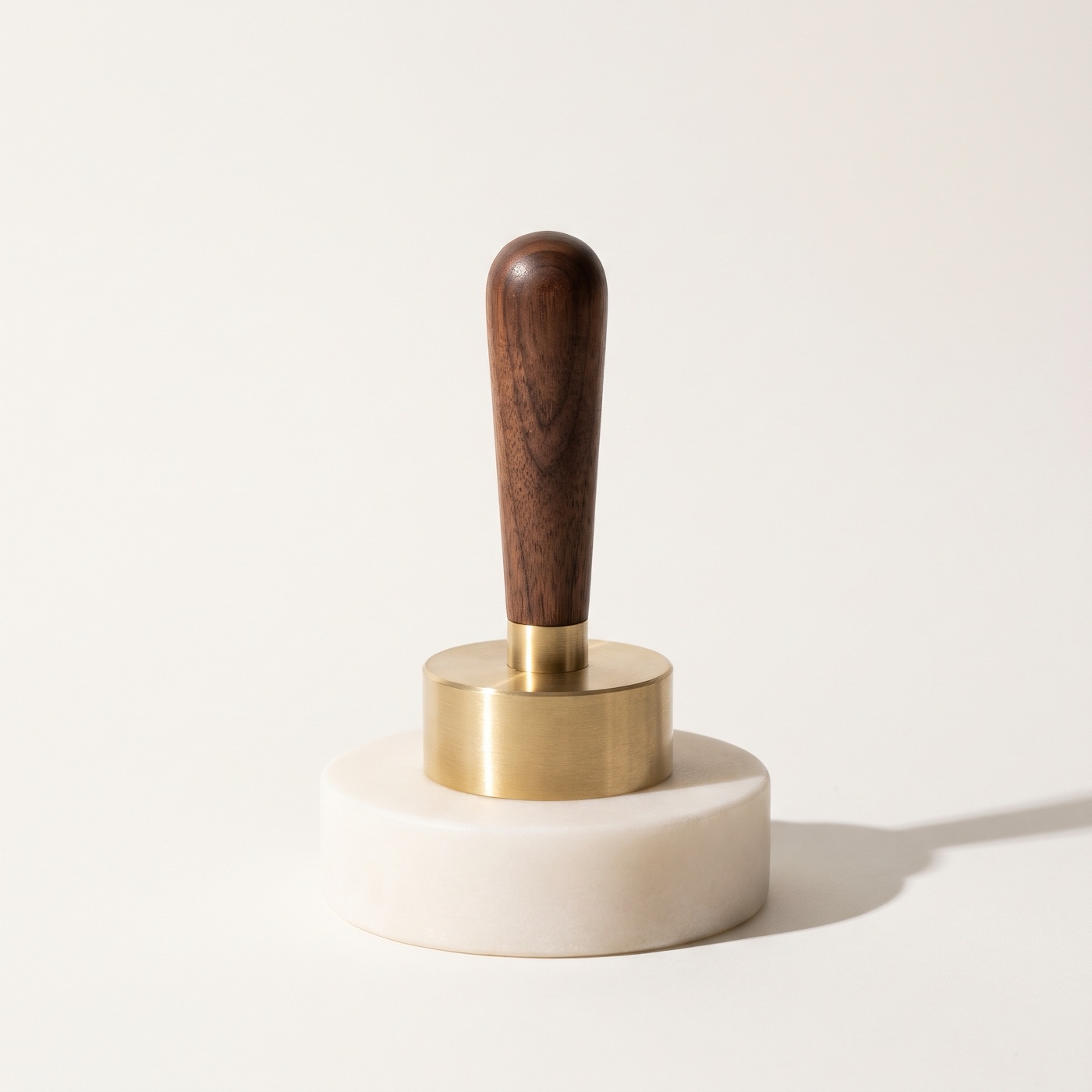
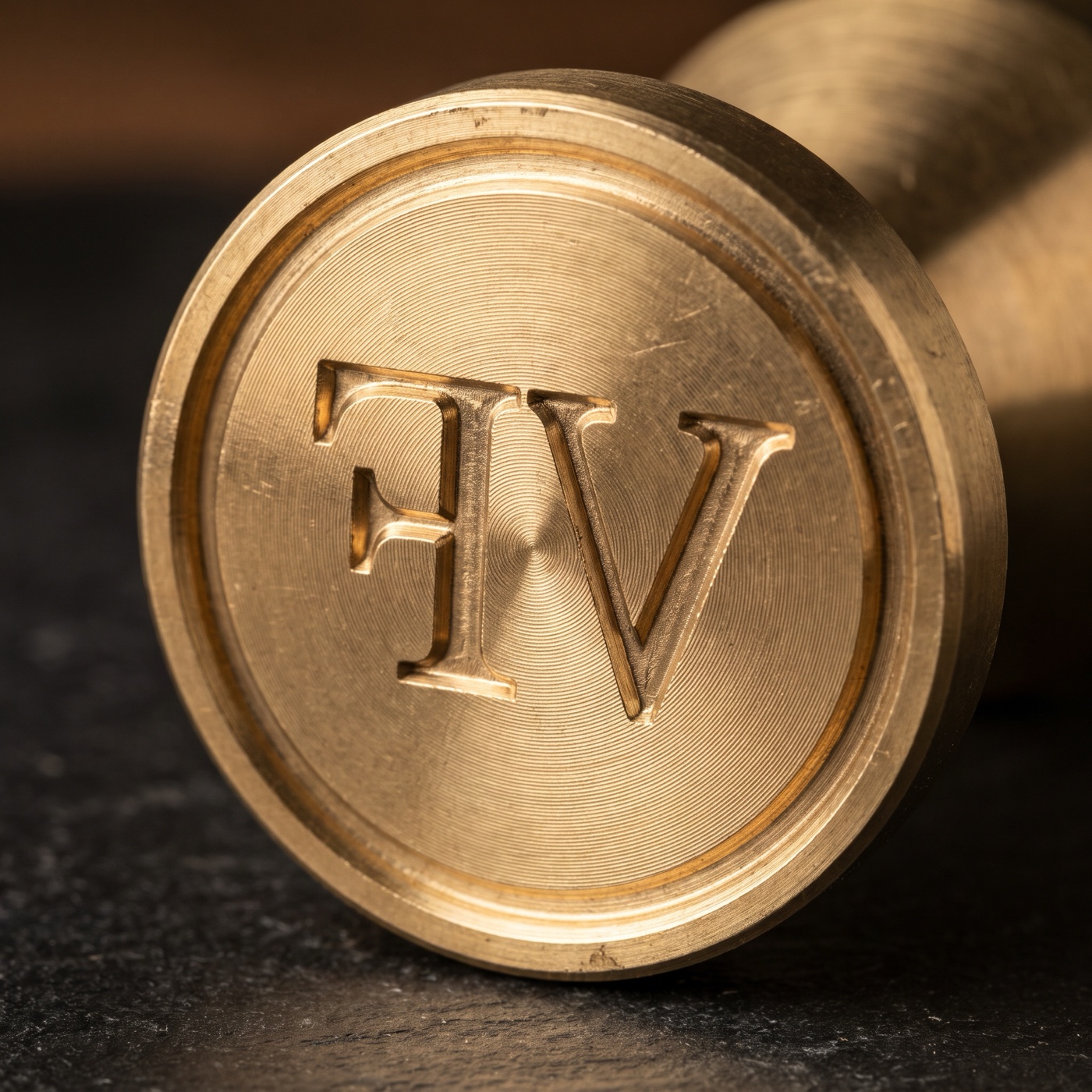
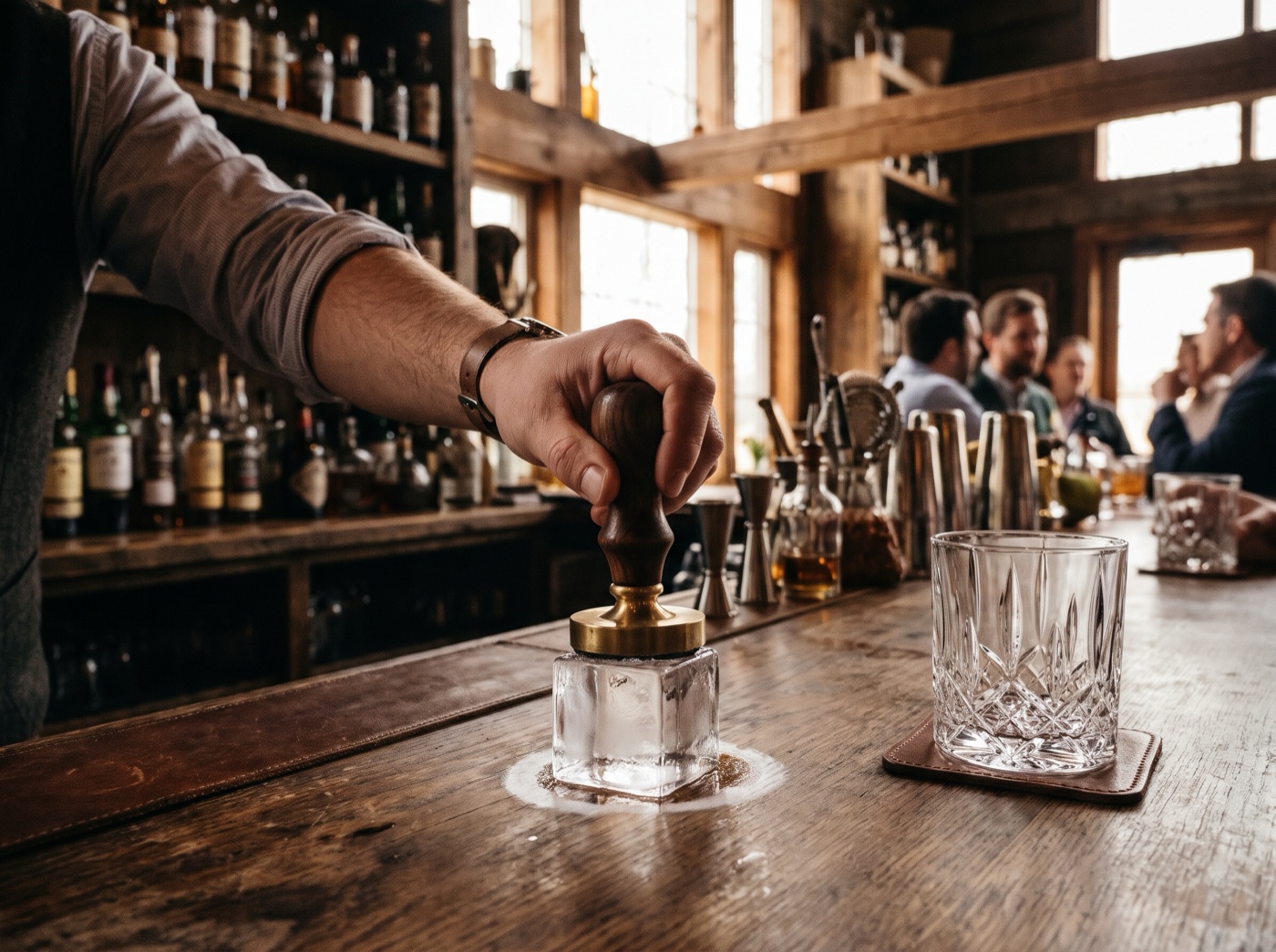
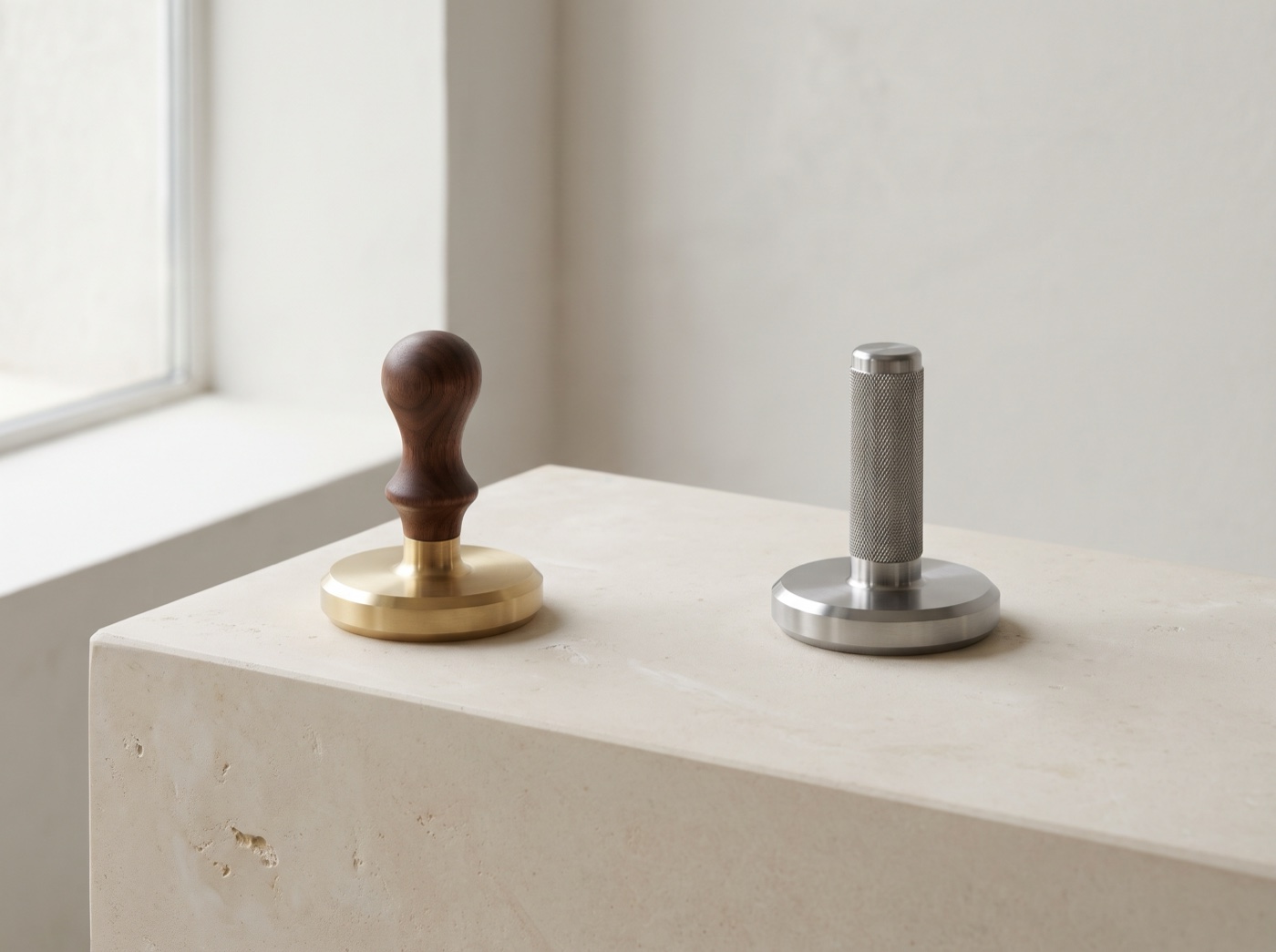
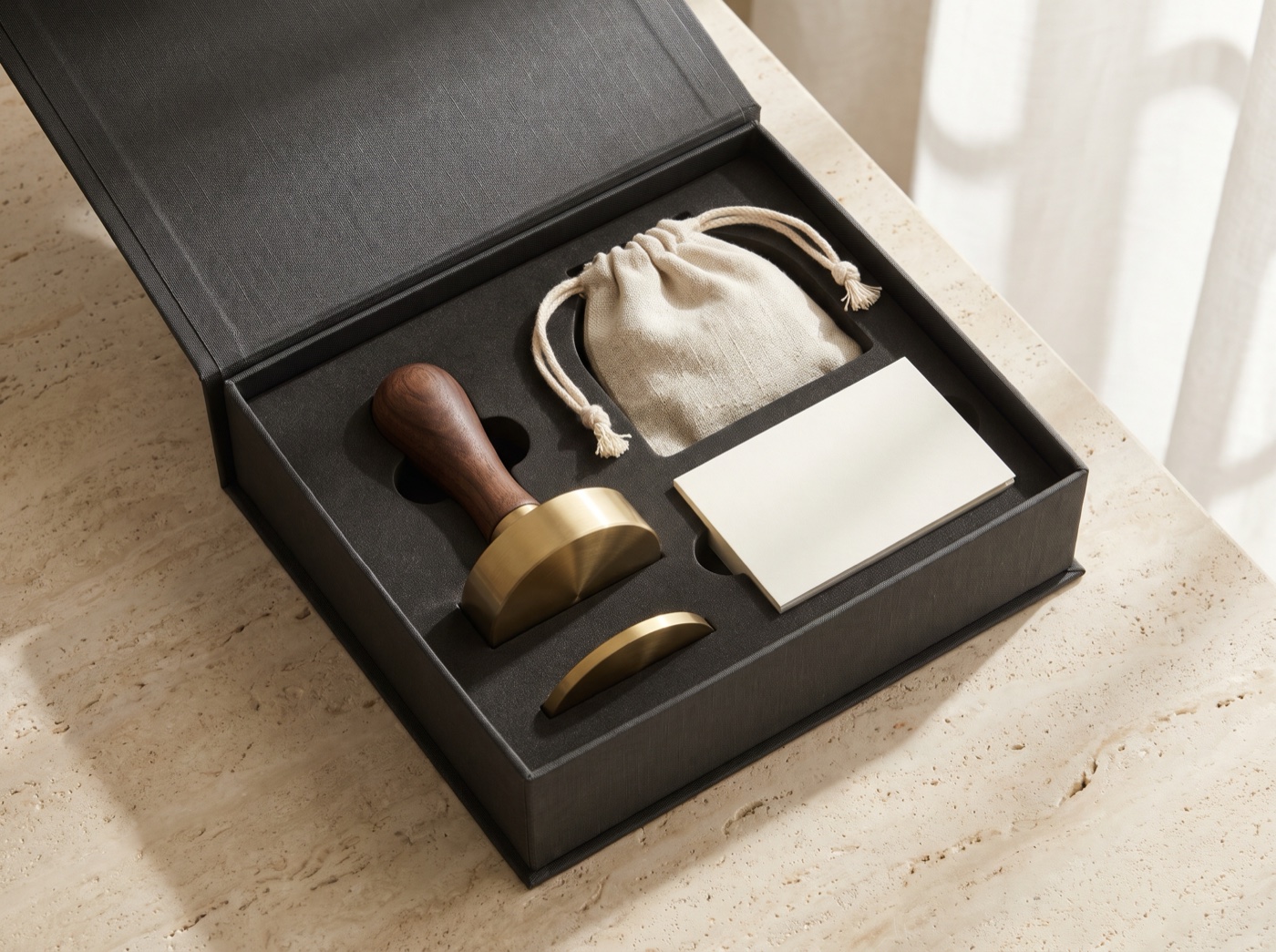
Studio images show the intended design, materials and packaging. Photos of production samples—including real impressions on ice and measured relief depth—will be published before orders open.
2-Inch Lead-Free Cocktail Ice Stamp
Your logo or monogram, made into a signature detail.
Bring your mark to cocktail ice with a custom brass stamp. A 2-inch face gives your design room to read, while a deep-relief cut gives the raised artwork clearance to meet the ice.
We check the lines, gaps, and layout at the size you choose. You review the proof before machining begins.
- Lead-free brass, with material information you can review.
- A 2-inch / 50.8 mm face, customized with your artwork.
- Deep-relief engraving, with your design checked at actual size.
- A digital proof to approve before your stamp is cut.
01 Choose your metal
Contact faceLead-free brass. Alloy grade, test scope and batch documentation will be published before orders open.
02 Find your size
Face diameterMeasure the flat top of your ice, not just the mold size. The 1.5″ and 2.5″ faces are proposed sizes.
03 Finish in hand
HandleHandle construction and the packaging list will be published with production samples.
04 Add a second mark
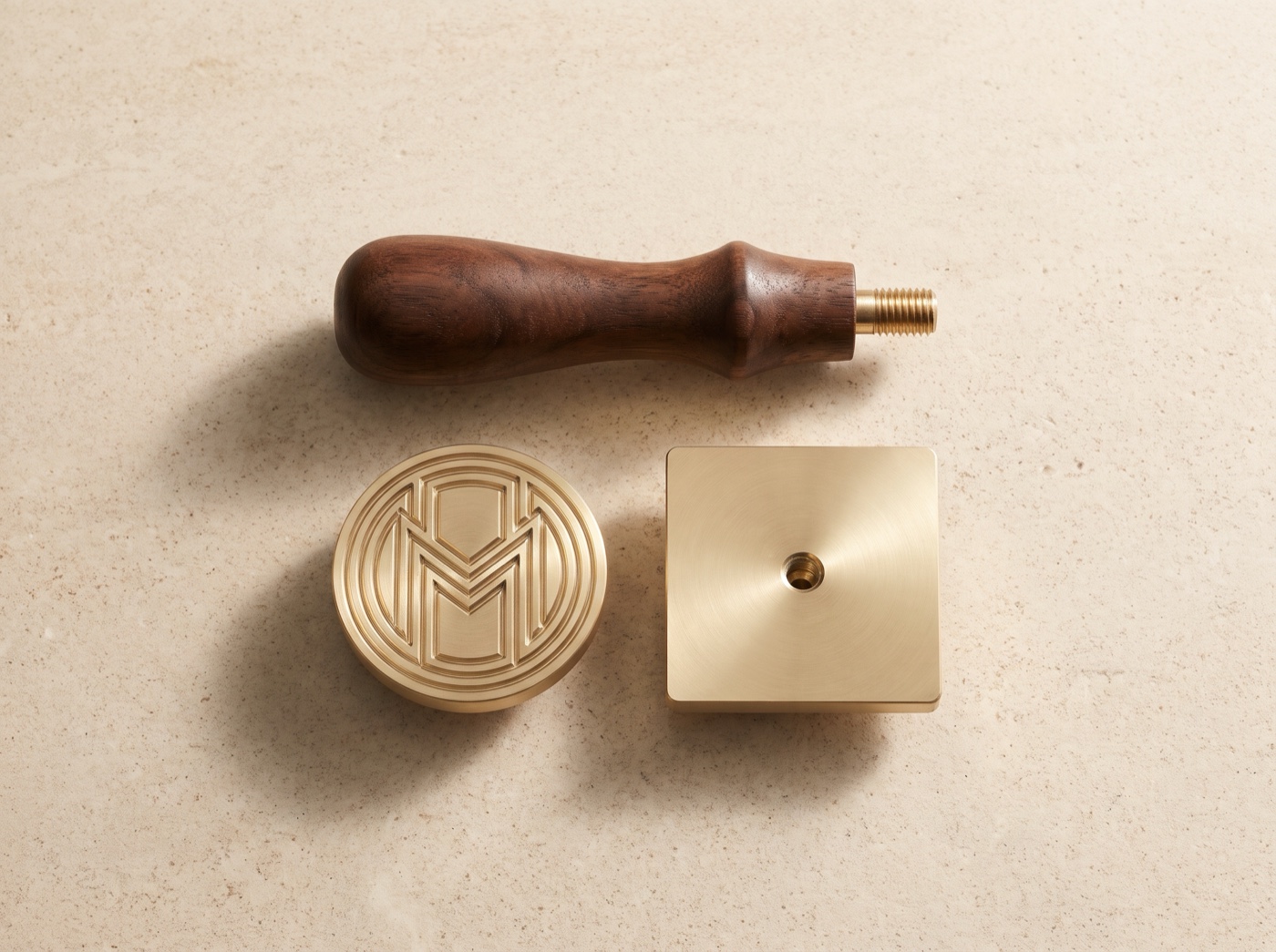
Optional · M8 threadScrews onto the same handle on an M8 brass thread, for $49 instead of a second $89 stamp. Upload the second artwork in the Studio. How it works
Your proof comes before machining. Shipping and any applicable taxes are shown before checkout. In this preview, the studio prepares your artwork check and configuration—no order is submitted and no payment is taken.
What you’re
actually getting.
The effective artwork area isn’t always the full 50.8 mm face. Tolerances, relief depth, handle construction and the packaging list are measured on production samples and added here—not estimated in advance.
| Stamp face | 2 inches / 50.8 mm nominal diameter |
|---|---|
| Material | Lead-free brass; see material documentation for the alloy and testing scope |
| Optional material | 304 stainless steel (+$15); behaves differently on ice |
| Artwork | Your logo, initials, or monogram; reviewed at final size |
| Engraving | Deep relief; final geometry confirmed in your production proof |
| Handle | Walnut (included) or solid 304 stainless (+$18) |
| Extra head | Optional second interchangeable custom head on an M8 brass thread (+$49) |
| Intended use | Brief contact with plain water ice, before the drink is poured |
| Approval | Digital proof approved before machining |
| Accepted files | SVG, PNG, or JPG. Simple, high-contrast artwork works best; outline text in vector files |
Your mark deserves
a little room.
Logos are often designed for screens and print. Ice asks something different of them. Hairline strokes, tight lettering, and small enclosed spaces can lose definition when a design becomes a physical impression.
We look at your artwork at its finished size, flag details that may need adjustment, and send a proof for approval. Sometimes the best change is a wider gap. Sometimes it’s a simpler line. Sometimes it’s choosing a different size.
Deep relief, with
the artwork to match.
The raised parts of the stamp form the impression. The recessed areas give them clearance. That geometry matters—but more depth alone won’t rescue a line that is too fine or a gap that is too tight.
We consider the artwork and the cut together, then show you the design before it becomes metal.
A blurry smudge,
or a crisp frosted mark.
Same ice, same monogram, same pour. The difference is what happens to meltwater in the first seconds of contact, and that is decided by relief depth and artwork spacing long before the stamp meets the ice.
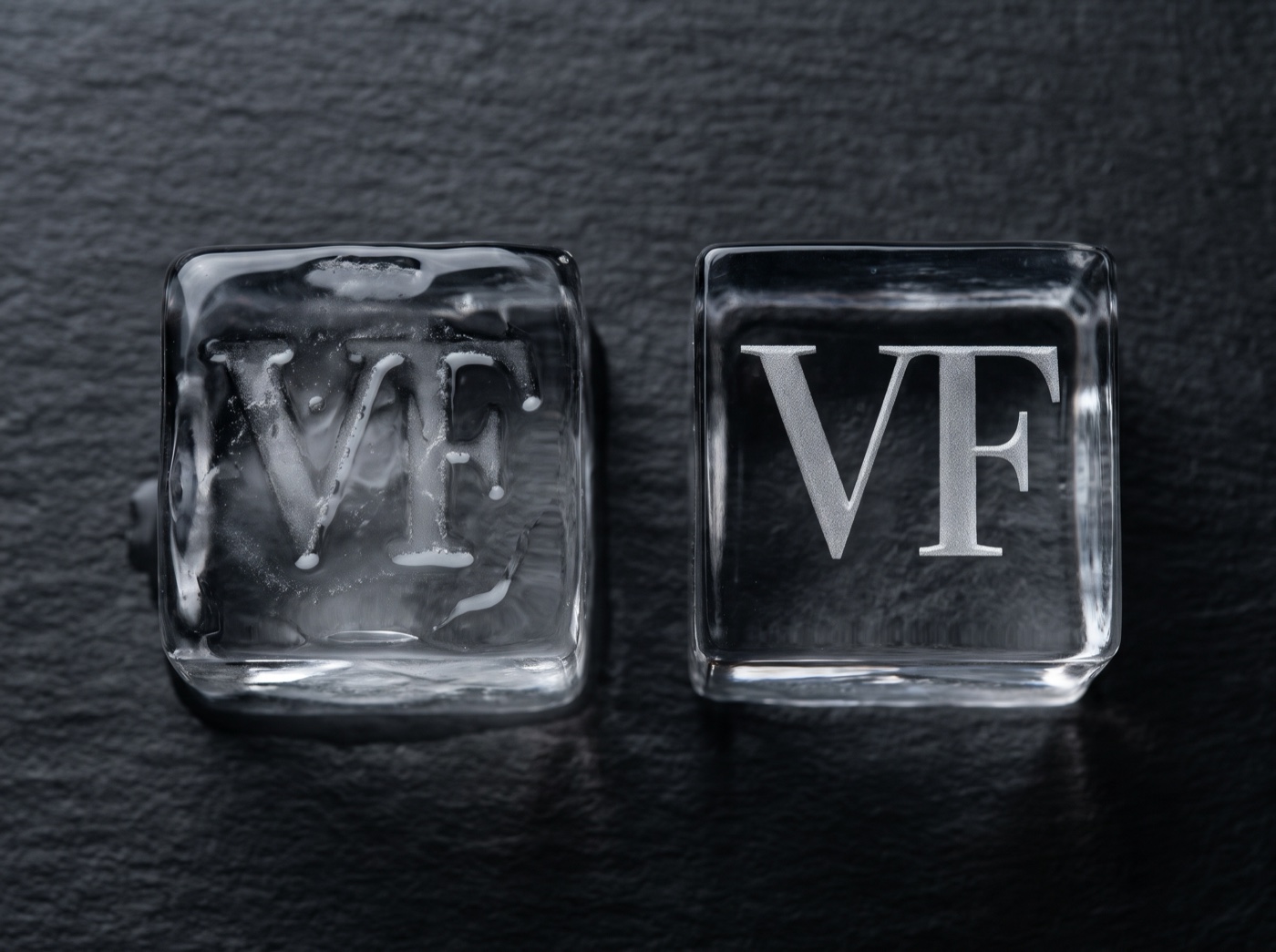
Meltwater has nowhere to go.
- The recessed background sits too close to the ice, so meltwater pools between the letters instead of draining away.
- Unchecked hairlines (under 0.50 mm at size) melt flat in the first second, and tight gaps (under 0.80 mm) bridge into one shape.
- The puddle refreezes as drips and halos, leaving a smudge where the monogram should be.
Meltwater drains. Edges stay sharp.
- Deep channels give meltwater room to run off the raised face, so the letters cut cleanly into a dry surface.
- Every stroke is screened to at least 0.50 mm and every gap to 0.80 mm at the final size, before any metal is cut.
- The result is an evenly frosted, sharp-edged imprint that reads across the bar and in photographs.
- Relief depth target
- ≥ 2.8 mmMeasured and confirmed in your proof
- Stroke screen
- 0.50 mmMinimum line width at final size
- Gap screen
- 0.80 mmMinimum counter and spacing
- When it’s checked
- Before CNCFree in the Studio, then in your proof
Depth alone does not rescue a hairline, and a clean file still needs tempered, flat ice. The 0.50 mm / 0.80 mm values are screening guidelines; your proof confirms the final geometry.
From artwork
to first pour.
- 01
Send your design.
Upload your logo or monogram. Use the free checker if you want to look at the details first.
- 02
Review your proof.
Check the layout, dimensions, and any proposed artwork changes. Machining begins after you approve it.
- 03
Make your mark.
Follow the care and use guide, test on a spare cube, and find the contact time that works for your ice and design.
Read the ice-stamping guide
Keep the handle.
Swap the mark.
Every Velt & Forge head screws onto its handle on a standard M8 brass thread. Keep one turned walnut or solid 304 steel handle and add a second custom head, cut to the same relief depth and checked the same way, for $49 instead of buying a second complete stamp.
- 01House crest + seasonal menuYour logo all year, plus a winter or summer menu mark for the bar team to swap in.
- 02Couple monogram + wedding dateA&M for the welcome drinks, the date for the toast, and both for every anniversary after.
- 03Home bar + leather maker’s markAn ice head for the bar and a leather head for the bench. Once a head has touched leather, dyes or finishes, keep it in the workshop and never use it on ice again.
Know what
you’re comparing.
A lower price can be a good fit. It should still come with enough information to understand the material, the cut, and the order process. Here are four details worth checking.
| What to compare | Our 2-inch stamp · US$89 | A US$24 listing with key details undisclosed* |
|---|---|---|
| Material information | Lead-free brass, supported by documentation for the specified material and intended use. | If only “brass” is stated, the alloy and lead content remain unverified. Ask for documentation. |
| Relief and readable detail | Deep relief, with artwork reviewed at the chosen size. Actual impression photos show the result. | If relief dimensions and actual impressions are absent, the cut and detail cannot be reliably compared. |
| Artwork approval | A digital proof is reviewed and approved before machining. | If proof approval is not described, confirm whether you can review the final layout before production. |
| Dispatch and order support | A stated dispatch estimate, plus an artwork record to help resolve questions about your order. | If production timing and support terms are missing, confirm them before purchase. |
Made for the ice,
before the cocktail.
Use the stamp on plain water ice before adding the drink. Start with a clean, flat surface and a clean stamp at room temperature. A short, steady contact is a better starting point than extra pressure.
Ice temperature, surface condition, artwork, and stamp material all affect the result. Practice on a spare cube before service. Do not heat the stamp with a flame, use it on flavored or acidic ice, or leave it sitting in a drink.
Where our brass sits
on the scale.
Our contact face is specified as bismuth lead-free eco-brass. This is how that specification compares with the US lead-free threshold and with leaded free-machining brass.
Lead-free metallurgy, on one honest scale.
-
Bismuth lead-free eco-brassVelt & Forge target spec · optical-spectrometer reading of an alloy sample~0.0022% Pb≈ 22 ppm
-
US NSF/ANSI 372 lead-free thresholdWeighted-average limit for drinking-water plumbing · reference benchmark0.25% Pb2,500 ppm
-
Free-machining C36000 brassCommon in industrial and unlabeled machined parts · nominal range2.5–3.7% Pb25,000–37,000 ppm
At ~0.0022% Pb, our target alloy sits over 110 times below the 0.25% NSF/ANSI 372 lead-free threshold, and over 1,000 times below the bottom of the C36000 range. On a linear scale our bar is barely a sliver; switch to the log view to see all three.
- What this is: a metallurgical alloy specification. The ~22 ppm figure comes from an optical-spectrometer reading of a supplier alloy sample, and every production batch is spectrometer-checked before dispatch. The batch report (laboratory, method, detection limit) is published before orders open.
- What it is not: a food-safety certification or a promise of zero lead. The 0.25% line is the US lead-free definition for drinking-water pipes, fittings and fixtures, shown as a benchmark; an ice stamp is not a plumbing product and is not NSF-certified by this comparison.
- C36000: nominal lead range from published Copper Development Association alloy data. It describes the alloy, not any particular seller’s product.
Understand
the material.
“Brass” is a family of alloys, not a complete material specification. Lead-free is also a claim that needs a clear basis. Review the material information for this stamp, including the alloy, what was tested, and the conditions the testing covers.
This stamp is intended for brief contact with plain water ice. Material composition alone does not establish suitability for every food, drink, temperature, or cleaning method.
We don’t describe this stamp as “FDA approved,” “Prop 65 certified,” “100% non-toxic,” or “zero lead.” Those phrases either don’t exist as product certifications or promise more than a material test can show.
Material documentation
Pre-launch · not yet published- Contact-face alloy gradeThe exact alloy designation (UNS number) of the stamp face, not just “brass.”To publish
- Batch composition reportLaboratory, method, detection limit, date, and the batch it applies to.To publish
- Basis of the “lead-free” claimWhich limit or standard the claim refers to, and why it is relevant to an ice stamp.To publish
- Testing scope for intended useBrief contact with plain water ice, and the recommended cleaning method.To publish
- Full bill of materialsHandle, ferrule, fasteners and any finish—matched to the SKU you receive.To publish
- Proposition 65 assessmentWhether a warning applies for sales into California, and where it would be shown.To publish
We won’t sell the lead-free brass stamp until these documents exist and match the item you receive. Need procurement documents for a bar or hotel? Ask before ordering—we’ll tell you what is available and what isn’t yet.
Before you
make your mark.
Clear ice, patina, lead-free claims, Prop 65, lead time and more—answered plainly.
Not yet. This page is a pre-launch preview. Orders open once the material documentation, production samples and our proof workflow are in place. You can already check your artwork and save a configuration in the free studio.
Clear ice makes the impression easier to see, especially in photographs, but clarity alone doesn’t determine whether a stamp works. A flat surface, suitable artwork, and the temperature of the ice matter too. A cloudy cube may take a mark that is simply harder to read. Directional freezing is one way to make clearer ice; boiling water alone does not reliably remove cloudiness. See how to get a clear impression on whiskey ice.
Not automatically. A nominal 2-inch cube may have rounded edges or a smaller flat top. Measure the usable surface, not just the mold size, and compare it with the artwork area shown in your proof. A little space around the design helps keep the impression clear of the edges.
There isn’t one contact time for every design and cube. Start with a clean stamp at room temperature, use brief contact, and inspect the result on a spare cube. Ice temperature, surface water, material, and the amount of raised artwork all change the result. Follow the supplied guide rather than adding force or heating the stamp.
It may need adjustment. We use 0.5 mm as an initial screening guideline for fine lines, then look separately at gaps, letter spacing, and the overall size. It is not a universal pass/fail rule. Upload your monogram to see which areas deserve attention; the final proof is reviewed before machining.
The background is recessed so the raised design can meet the ice with clearance around it. Relief depth is different from the depth of the impression in the ice. The final result also depends on artwork, ice conditions, and contact time. More engraving depth by itself does not guarantee a clearer mark.
Brass can change color over time. That surface change is different from knowing whether a material is suitable for its intended use. Wash with mild dish soap, rinse, and dry thoroughly. Avoid acidic cleaners, abrasive pads, and unapproved polishes on the contact face. If you see green deposits, pitting, or a damaged surface, stop using the stamp and contact us before putting it back into service.
Wash before first use and after use with mild dish soap and water, then rinse and dry thoroughly. Do not put it in a dishwasher unless the supplied care instructions explicitly allow it. Professional bars should also follow a sanitizing procedure compatible with the stamp’s materials and their local food-safety requirements; washing and sanitizing are different steps.
It is a material claim, not a universal food-safety certification and not a promise of chemically zero lead. Our material documentation explains the alloy, the basis for the claim, and the scope of testing for the intended use. If you need procurement documents, ask for them before ordering. We do not describe the stamp as “FDA approved” or “Prop 65 certified.”
C36000 is a free-cutting brass alloy that contains lead. That makes an exact alloy specification more useful than the word “brass” alone. It does not mean every brass stamp uses C36000, and it does not tell you what is in an individual product without documentation. Ask the seller for the grade and relevant test information. Read Lead-Free Brass, C36000, and What to Ask Before You Buy.
A warning concerns potential exposure to a listed chemical. It is not a product certification or, by itself, a measurement of the exposure from a particular use. The absence of a warning is not proof of zero lead, either. Our materials guide separates alloy composition, intended use, testing, and warning requirements so you can ask more specific questions.
Stamp plain water ice first. Do not place the brass face in a finished drink or use it on acidic or flavored ice. Brass has additional limitations around acidic food contact; “lead-free” does not remove those limitations. If your workflow requires different contact conditions, check them before selecting a material.
Check the dispatch estimate shown for your order. Production starts after you approve the final proof, so the clock does not start when you first upload a file. Artwork changes, weekends, holidays, and production capacity can affect timing. Dispatch means the parcel has been handed to the carrier; delivery to the US, UK, or Australia takes additional time.
Tell us the event date and destination before ordering. Allow time for artwork approval, production, shipping, and a trial run with your bar team. We’ll confirm whether the current schedule can accommodate the date. Do not rely on a dispatch estimate as an event-delivery guarantee.
Use a stamp designed and specified for the material and equipment involved. Our ice stamps and leather stamps are separate products. Do not hammer an ice stamp or fit it to a press unless its specification explicitly allows it, and do not use a tool on food after it has been used with leather, dyes, finishes, or workshop chemicals.
Yes—the selector above adds 304 stainless steel for US$15. It behaves differently from brass on ice, so do not expect the same contact time. A material grade alone is not a guarantee of performance or suitability for every use; its documentation is published alongside the brass documentation before orders open. See the 304 stainless steel ice stamp for a full comparison.
Yes. Heads screw onto the handle on an M8 brass thread, so a second custom head (a seasonal menu mark, a wedding date or a crest) is $49 instead of a second $89 stamp. Each head is checked at final size and proofed separately.
Contact us with your order number and clear photos of the stamp and impression. We’ll compare them with the approved artwork and help identify whether the issue is the stamp, the design, or the stamping conditions. The published order policy explains the available remedy for a manufacturing defect or an incorrect item.